Post-Communist Parliaments: Change and Stability in the Second Decade by David M. Olson & Gabriella Ilonszki
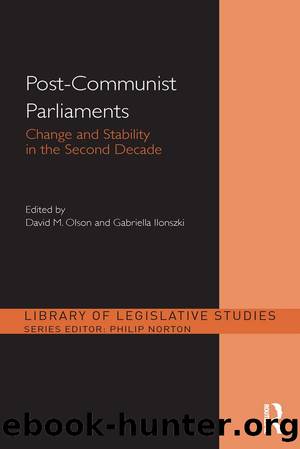
Author:David M. Olson & Gabriella Ilonszki [Olson, David M. & Ilonszki, Gabriella]
Language: eng
Format: epub
Tags: Political Science, Political Ideologies, Communism; Post-Communism & Socialism, Political Process, Political Parties
ISBN: 9780415560832
Google: KJ6hXwAACAAJ
Goodreads: 13712762
Publisher: Routledge
Published: 2011-01-15T12:41:27+00:00
The above discussion of negative agenda powers reveals a rather complex picture of diverse institutional mechanisms that majority parties can use to block or delay opposition bills from reaching the floor (see Table 4). It is interesting to note that majority parties in all six central European parliaments have recourse to at least some procedural levers of negative agenda control. These opportunities become more and more extensive the more advanced the stage of the legislative process. The fairly liberal rules on recognition and access to the order book give way to more restrictive constraints on access to the first reading. The latter are, in turn, superseded by an extensive array of negative agenda powers to be exercised before the second and third floor readings.
How do the six parliaments vary on the powers of negative agenda control? If one considers the breadth of procedural instruments, three distinct groups can be discerned. First, majority parties in Hungary and Poland have at their disposal the most extensive chest of negative agenda powers. In Hungary, the committees and the floor have full control over the agenda. In Poland, the floor and committees share the agenda control powers with a powerful speaker. Secondly, the Czech Republic, Estonia (before 2003) and Slovenia (both before and after 2002) have moderate procedural opportunities for negative agenda control. Committees and the floor may block opposition bills, but parliamentary minorities have recourse to important protection instruments. Finally, in Slovakia and Estonia (after 2003) the governing parties enjoy the scarcest negative agenda powers. In both countries, the main procedural option available to governing majorities is the ability to delay the committee report for the second reading.
To what extent does this pattern of variation confirm the theoretical propositions formulated at the start of the article? Proposition 1a seems to be confirmed. Figure 2 shows the relationship between the effective number of parties (as per data from Table 2) and the range of procedural opportunities to block or delay opposition bills from floor deliberations (as per data from Table 4).4 It reveals a strong negative relationship between the two variables with a Pearson's coefficient of â0.69 (significant at 0.01 level, one-tailed test). Parliaments with a low effective number of parties tend to provide majorities with more extensive procedural
Download
This site does not store any files on its server. We only index and link to content provided by other sites. Please contact the content providers to delete copyright contents if any and email us, we'll remove relevant links or contents immediately.
| Anthropology | Archaeology |
| Philosophy | Politics & Government |
| Social Sciences | Sociology |
| Women's Studies |
The Secret History by Donna Tartt(19088)
The Social Justice Warrior Handbook by Lisa De Pasquale(12190)
Thirteen Reasons Why by Jay Asher(8909)
This Is How You Lose Her by Junot Diaz(6887)
Weapons of Math Destruction by Cathy O'Neil(6280)
Zero to One by Peter Thiel(5802)
Beartown by Fredrik Backman(5754)
The Myth of the Strong Leader by Archie Brown(5507)
The Fire Next Time by James Baldwin(5445)
How Democracies Die by Steven Levitsky & Daniel Ziblatt(5218)
Promise Me, Dad by Joe Biden(5153)
Stone's Rules by Roger Stone(5088)
A Higher Loyalty: Truth, Lies, and Leadership by James Comey(4964)
100 Deadly Skills by Clint Emerson(4925)
Rise and Kill First by Ronen Bergman(4789)
Secrecy World by Jake Bernstein(4753)
The David Icke Guide to the Global Conspiracy (and how to end it) by David Icke(4719)
The Farm by Tom Rob Smith(4509)
The Doomsday Machine by Daniel Ellsberg(4490)
